
Benchmark of an intelligent financial and operational platform
CERP or traditional financial software?
A comparison for a smart, future-ready choice
20+ years of retail experience32+ integrated modulesCloud + keeps working offlineBuilt with AI agents
Infographic: CERP compared with traditional financial software
Choose the English or Persian version of the benchmark to view.
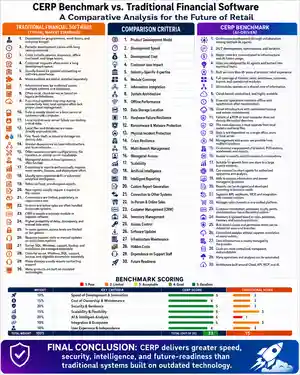
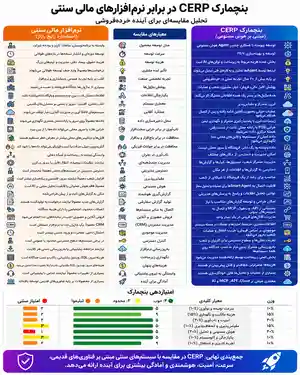
Comparison table: CERP and traditional financial software
| Criterion | CERP | Traditional financial software | Customer benefit |
|---|---|---|---|
| Development model | Continuous development with several AI agents working together | Depends on headcount, working hours and the vendor’s budget | Faster delivery of features and improvements |
| Development speed | Round-the-clock analysis and optimisation | Releases at long intervals | Shorter time from request to implementation |
| Specialist experience | More than 20 years of hands-on retail experience | Mostly generic accounting analysis | Closer fit with real store operations |
| Module coverage | Finance, sales, inventory, CRM, branches, online and operations in one platform | Separate modules or applications | Fewer systems to buy and maintain |
| Data integration | One shared data core across all modules | Scattered data and repeated entry | Fewer discrepancies and human errors |
| Architecture | Cloud-based, centralised, modern and extensible | Mostly on-premises or client-server | Better access and extensibility |
| Internet outage | Essential operations continue offline and sync once reconnected | Pure cloud systems stop, or local systems lack cloud management | Sales and operations never stop |
| Security and backup | Centralised backup and storage; less reliance on a single device | Depends on the customer’s server, disk or PC | Lower risk from failure, theft, accidents and ransomware |
| Branch management | Central control of branches, registers and warehouses | Needs infrastructure and complex data transfer | A real-time view of the whole business |
| Scalability | From a single store to a network of branches | Costly expansion, more licences and servers | Grow without replacing your software |
| Artificial intelligence | Operational AI, analysis, automation and natural-language interaction | Limited, cosmetic or no AI | Faster decisions and execution |
| Reporting | Dashboards, a report builder and smart analysis | Fixed, pre-designed reports | Faster answers to management questions |
| Connectivity | API, webhooks, MCP and online sales integration | Limited or proprietary integrations | Simpler integration with other services |
| In-store and online sales | All sales channels in one hub | A separate system for each channel | Unified stock, prices and orders |
| Updates | Centralised, with no separate installation on every machine | Installing and updating each client one by one | Lower cost and less disruption |
| Total cost of ownership | Centralised and more predictable costs | Separate server, SQL, Windows, backup, installation and support | Fewer hidden costs |
| Future readiness | Cloud, API, MCP and AI agents | Tied to older architectures and technologies | Ready for future market changes |
Scored benchmark
Scale: 1 poor, 3 acceptable, 5 excellent. These scores are CERP’s internal assessment; a formal comparison with a specific product requires an independent, scenario-based test.
| Criterion | Weight | CERP | Traditional software |
|---|---|---|---|
| Development speed and innovation | 10% | 5 | 2 |
| Module integration | 10% | 5 | 3 |
| Data security and resilience | 10% | 5 | 2 |
| Offline operation | 8% | 5 | 3 |
| Cloud usability | 8% | 5 | 2 |
| Multi-branch management | 8% | 5 | 3 |
| AI and automation | 10% | 5 | 1 |
| Management reporting | 8% | 5 | 3 |
| Connections to other systems | 8% | 5 | 2 |
| Scalability | 7% | 5 | 3 |
| Total cost of ownership | 7% | 4 | 2 |
| Specialist retail experience | 6% | 5 | 3 |
| Final score out of 100 | 100% | 98.6 | 47.4 |
CERP is more than software
It is an intelligent development team and a platform that keeps growing.
The power of the cloud, the reliability of offline operation and the speed of AI-driven development — in one integrated ecosystem.